The Secret Your Local Mechanic Doesn’t Want You to Know About Foggy Headlights
The secret your local mechanic doesn’t want you to know about foggy headlights is that you probably have the solution sitting in your medicine cabinet right now. We have all been there, walking out to the driveway and noticing that the once-crisp “eyes” of our vehicle look tired, yellowed, and cloudy. It ages a car instantly, making even a well-maintained engine feel like it belongs in a scrapyard.
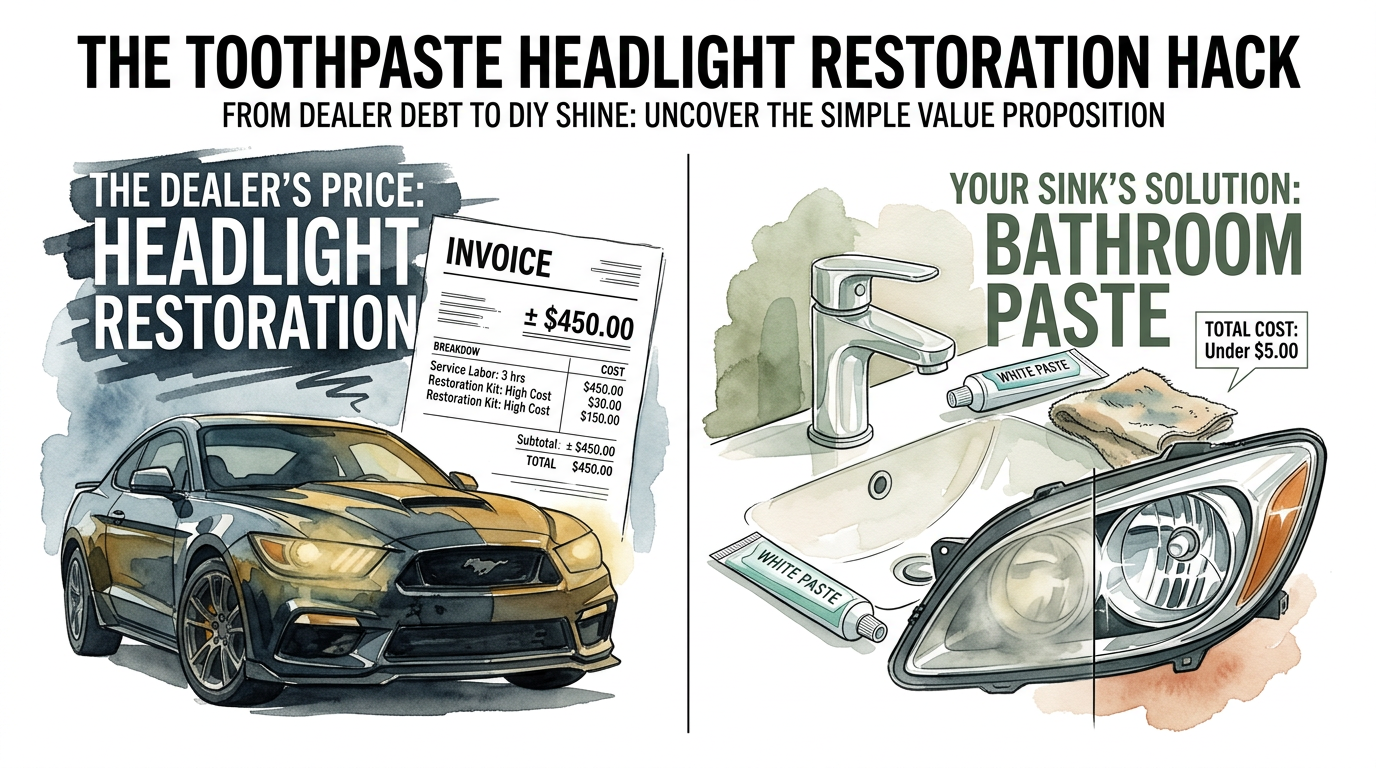
Cloudy headlights are a safety hazard, but you don’t need a professional kit to fix them. A tube of non-gel toothpaste and 5 minutes of elbow grease can restore clarity for cents. Here is how I did it. This isn’t just a cheap trick; it is a fundamental application of surface polishing that enthusiasts have used for years to get out of a pinch.
If you have ever looked at a repair bill for headlight restoration, you know it can range from $100 to $150 at a dealership. They often use the same mechanical principles we are going to discuss today. By understanding the science of your car’s exterior, you can save your hard-earned money for the next oil change or a set of new tires.
In this guide, we are going to dive deep into the world of polycarbonate maintenance. We will explore why headlights get foggy in the first place and why a simple tube of toothpaste is often more than enough to reverse years of environmental damage. Let’s get your car looking showroom-ready again.
What is the Toothpaste Headlight Restoration Hack?
To understand the hack, you first have to understand what your headlights are made of. Modern vehicles use polycarbonate plastic rather than the heavy, breakable glass used in the mid-20th century. Polycarbonate is durable and impact-resistant, but it has one major weakness: it is porous and reacts poorly to UV radiation from the sun.
Over time, the factory-applied clear coat on these plastic lenses begins to degrade. This leads to oxidation, which manifests as that ugly, milky, or yellowed film. When you use toothpaste to clean them, you aren’t just “washing” the lens; you are performing a microscopic sanding procedure. Toothpaste contains mild abrasives designed to scrub plaque off teeth without destroying the enamel.
Think of the toothpaste as a very fine liquid sandpaper. It levels out the oxidized pits in the plastic, smoothing the surface so light can pass through cleanly again. It is a nostalgic approach to car care that reminds us that sometimes the simplest tools are the most effective. You don’t always need a high-speed orbital buffer to see a massive difference.
How It Works / How to Do It
Restoring your headlights with toothpaste is a straightforward process, but it requires the right technique to ensure you don’t scratch the plastic or damage your car’s paint. Follow these steps for the best results.
Step 1: Choose the Right Toothpaste
This is the most critical part of the process. You must use a standard, white, non-gel toothpaste. Avoid the fancy translucent gels or toothpastes with “cooling crystals.” The white, opaque pastes usually contain baking soda or silica, which provide the abrasive quality needed to polish the plastic. Whitening toothpastes are often the best because they have a slightly higher grit count.
Step 2: Clean and Prep the Surface
Before you start polishing, wash the headlight with soap and water to remove any loose dirt, grit, or road grime. If you skip this, you might end up rubbing a piece of sand into the plastic, causing deep scratches that are hard to remove. Once dry, use painter’s tape to mask off the area around the headlight. This protects your car’s paint from the abrasive paste.
Step 3: Apply the Paste
Squeeze a generous amount of toothpaste onto a soft microfiber cloth or a damp sponge. Apply it directly to the headlight lens. You want a layer that covers the entire foggy area. Don’t be afraid to use a little more than you would on a toothbrush; we are dealing with a much larger surface area here.
Step 4: The Elbow Grease Phase
Work the toothpaste into the lens using firm, circular motions. Start from one corner and work your way across. You should notice the paste turning a yellowish or brownish color—this is the oxidation being lifted off the plastic. Keep scrubbing for about 2 to 5 minutes per headlight. If the paste starts to dry out, add a small spritz of water to keep it lubricated.
Step 5: Rinse and Inspect
Use a clean, wet cloth or a hose to thoroughly rinse away all the toothpaste residue. Dry the lens with a clean towel. At this point, you should see a significant improvement in clarity. If there are still stubborn foggy spots, simply repeat the process. Some older lenses might require two or three passes to fully clear up.
Step 6: The “Pro” Secret—Protecting the Work
The toothpaste removes the oxidation, but it also removes what was left of the protective UV coating. If you stop here, the headlights will fog up again in a few weeks. To keep them clear, apply a coat of high-quality car wax or a dedicated UV sealant. This creates a barrier against the sun and keeps your hard work looking fresh for months.
Benefits / Advantages
Why choose this method over a store-bought kit or a professional service? The advantages go beyond just saving a few dollars.
- Extreme Cost Efficiency: A tube of toothpaste costs roughly $2 to $5, and you likely already have it. Compared to a $25 restoration kit or a $150 pro service, the savings are undeniable.
- Safety and Accessibility: Unlike heavy-duty chemicals or sandpaper, toothpaste is relatively mild. It is very difficult to “ruin” your headlights with toothpaste, making it the perfect entry-level DIY project.
- Time Saving: You can finish both headlights in under 15 minutes. There is no need to drop your car off at a shop or wait for a professional to fit you into their schedule.
- Immediate Safety Results: Foggy headlights can reduce light output by up to 70%. Cleaning them instantly improves your night vision and makes your vehicle more visible to others.
Challenges / Common Mistakes
While this is a simple hack, there are a few ways things can go wrong. Being aware of these pitfalls will help you get a “like-new” finish every time.
The most common mistake is using the wrong type of toothpaste. Gel-based formulas lack the abrasive power needed to cut through oxidation. If you use a gel, you are essentially just giving your car a minty-fresh wash without actually fixing the problem. Always stick to the chalky, white stuff.
Another challenge is internal oxidation. Sometimes the “fog” isn’t on the outside of the lens, but on the inside. This happens if the headlight seal is broken and moisture or dust has entered the housing. If you scrub the outside and nothing changes, the issue is likely internal. In that case, the toothpaste hack won’t help, and you may need to replace the unit or bake the seal open—a much more advanced task.
Finally, failing to seal the lens after polishing is a major error. Raw polycarbonate is very sensitive to the sun. Without a wax or sealant, the “new” surface you just exposed will oxidize faster than the original one did. Always finish with a UV protectant.
DEALER QUOTE vs BATHROOM SINK
When you take your car to a professional, they are often performing the same physical process—abrasion and polishing—just with different tools. Here is how the “Bathroom Sink” method stacks up against the “Dealer Quote.”
| Feature | Dealer / Pro Service | Bathroom Sink Hack |
|---|---|---|
| Average Cost | $80 – $150 | $0.50 (estimated use) |
| Time Required | 1 – 2 Hours | 10 – 15 Minutes |
| Tools Used | Power Buffer, Sandpaper | Toothpaste, Microfiber |
| Longevity | 6 – 12 Months | 3 – 6 Months (with wax) |
| Convenience | Low (Requires appointment) | High (Do it anytime) |
The table clearly shows that while a pro service might last slightly longer due to the use of heavy-duty industrial sealants, the “Bathroom Sink” method is unbeatable in terms of value and convenience. For most daily drivers, the toothpaste method is more than sufficient to maintain safety and aesthetics.
Practical Tips / Best Practices
If you want to take your headlight restoration to the next level, consider these “car enthusiast” tips that I have picked up over the years.
- Warm it up: If you are working in cold weather, the plastic can be less responsive. I like to do this on a lukewarm day or after the car has been running for a few minutes so the headlight housings are slightly warm to the touch.
- The “Magic Eraser” Combo: If your oxidation is particularly thick, you can use a melamine sponge (Magic Eraser) with a dab of toothpaste. This increases the abrasive power significantly. Just be extra careful not to hit your paint!
- Consistent Pressure: Don’t press too hard. You aren’t trying to grind through the plastic; you are trying to polish it. Let the abrasives in the paste do the work. Consistent, medium pressure is better than heavy, erratic pressure.
- Don’t Forget the Edges: People often focus on the center of the lens and forget the corners. Make sure you get the paste all the way to the edges of the plastic for a uniform look.
- Use a Circular Motion: Straight lines can leave visible “scratches” or streaks. Small, tight circles create the smoothest finish, much like when you are waxing the body of the car.
The Science of Visibility
Why does this matter so much? From a car enthusiast’s perspective, it’s about more than just looks. It’s about the physics of light. When your headlights are cloudy, the light from the bulb hits those microscopic pits and scratches in the plastic. Instead of beaming forward in a focused pattern, the light scatters in every direction.
This “scatter” effect is what causes that dim, hazy glow that doesn’t reach the road. It also creates glare for oncoming drivers, as the light is diffused upward toward their eyes. By polishing the surface back to a flat, clear finish, you allow the internal reflectors of the headlight assembly to do their job. You get more “throw” (the distance the light travels) and a sharper “cutoff” (the line where the light stops). It’s one of the most effective safety upgrades you can perform on an older vehicle.
Final Thoughts
Restoring your headlights doesn’t have to be a major weekend project or a drain on your wallet. By reaching for a tube of toothpaste, you are participating in a long tradition of DIY car maintenance that prioritizes practical results over expensive packaging. It is a satisfying, quick win that makes an immediate difference in how your car looks and performs at night.
Remember that the key to any successful restoration is the finish. Whether you use the toothpaste hack or a professional kit, always ensure you apply a UV protectant afterward. This preserves the clarity you’ve worked so hard to achieve and protects the polycarbonate from the harsh rays of the sun. It is the difference between a temporary fix and a long-term solution.
Next time you see a friend or neighbor struggling with yellowed headlights, share the secret. It’s a small way to keep our roads safer and our cars looking their best. There is a certain pride in taking care of the details yourself, especially when the solution is as simple as something from your bathroom sink. Happy polishing, and enjoy the clear view of the road ahead!